
Realistic VFX Masterclass
Break down real-world references and translate physical behavior into simulation logic and particle systems. The science behind fire, smoke, water, and destruction.

Mustafa Alobaidi
Senior VFX artist


Most beginner VFX problems are not technical they are observational.
Before you can build believable effects, you need to train your eye to understand how real-world phenomena behave: how fire moves, how smoke breaks apart, how light reacts, how timing sells weight, and how every effect has a lifecycle.
This course is the starting point I wish existed when artists asked me where to begin.
It is not a software tutorial. It is the foundation underneath every realistic effect you will ever create. You will learn how to observe reality like an FX artist, break reference down into usable information, and think about VFX as behavior, timing, and structure not just particles on a screen.
By the end, you will build a fully realistic campfire using everything you have learned. But the campfire is only the proof. The real result is a sharper eye, a stronger process, and a framework you can use for every effect after it.
The course is free and released module by module over time. New modules are added as they are recorded, and early students help shape what comes next.
What You'll Learn
✓
How to actually see realism instead of guessing at it
✓
How to gather, read, and break down references like a professional FX artist
✓
The art fundamentals that make FX feel real value, color, light, and composition
✓
How real-time FX pipelines work and why games are different from film
✓
How to build a fully realistic campfire from sim to engine
✓
How to critique your own work and keep improving after the course ends
Course Curriculum
1 Foundations of Realistic FX
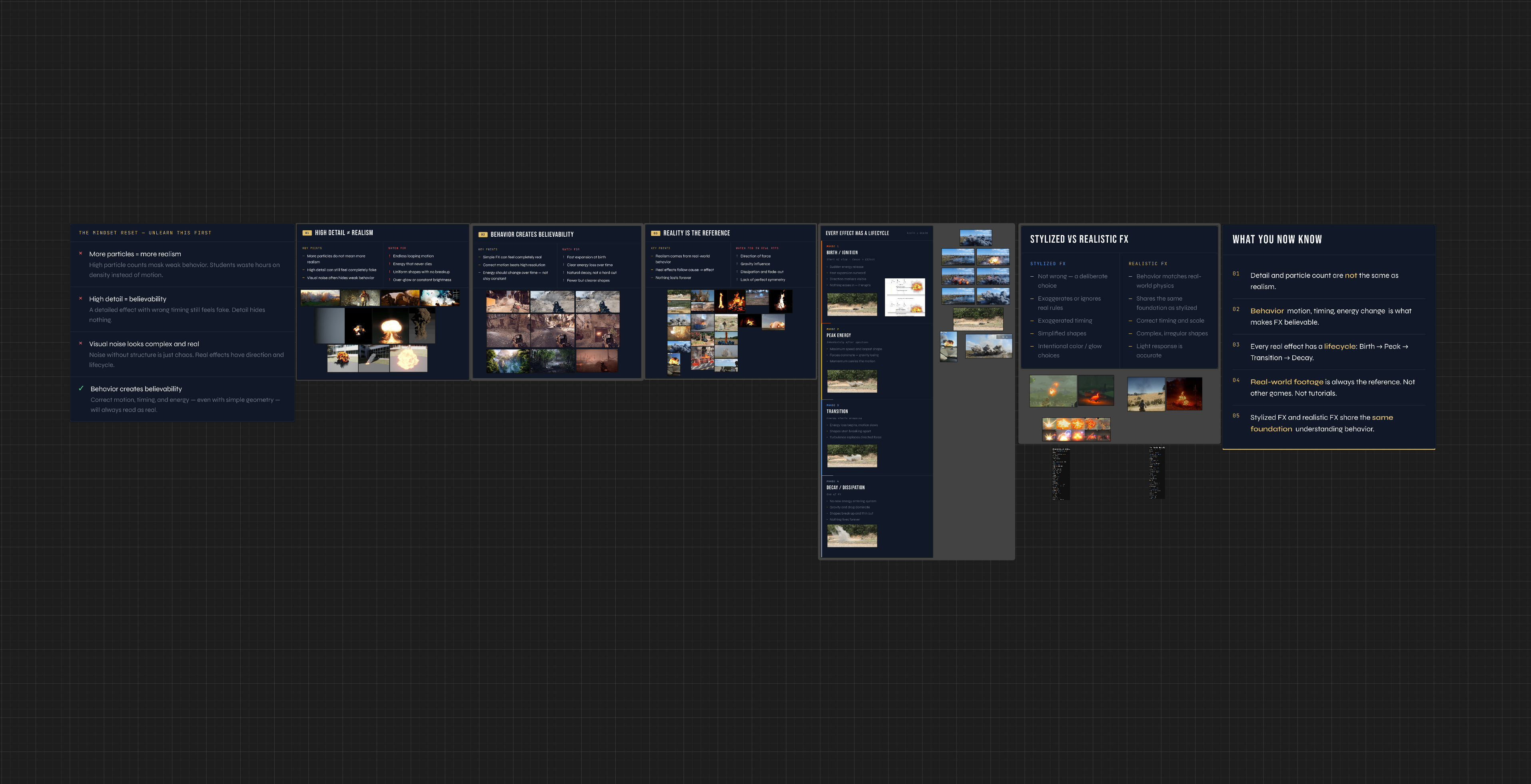
Most FX artists start by opening an engine and tweaking parameters. This module starts earlier. You will learn what realistic actually means, why most game FX fails at it, and how to train your eye to see the difference between an effect that looks real and one that just looks busy. This is the mindset shift the rest of the course is built on.
2 Reading Reality Like an FX Artist
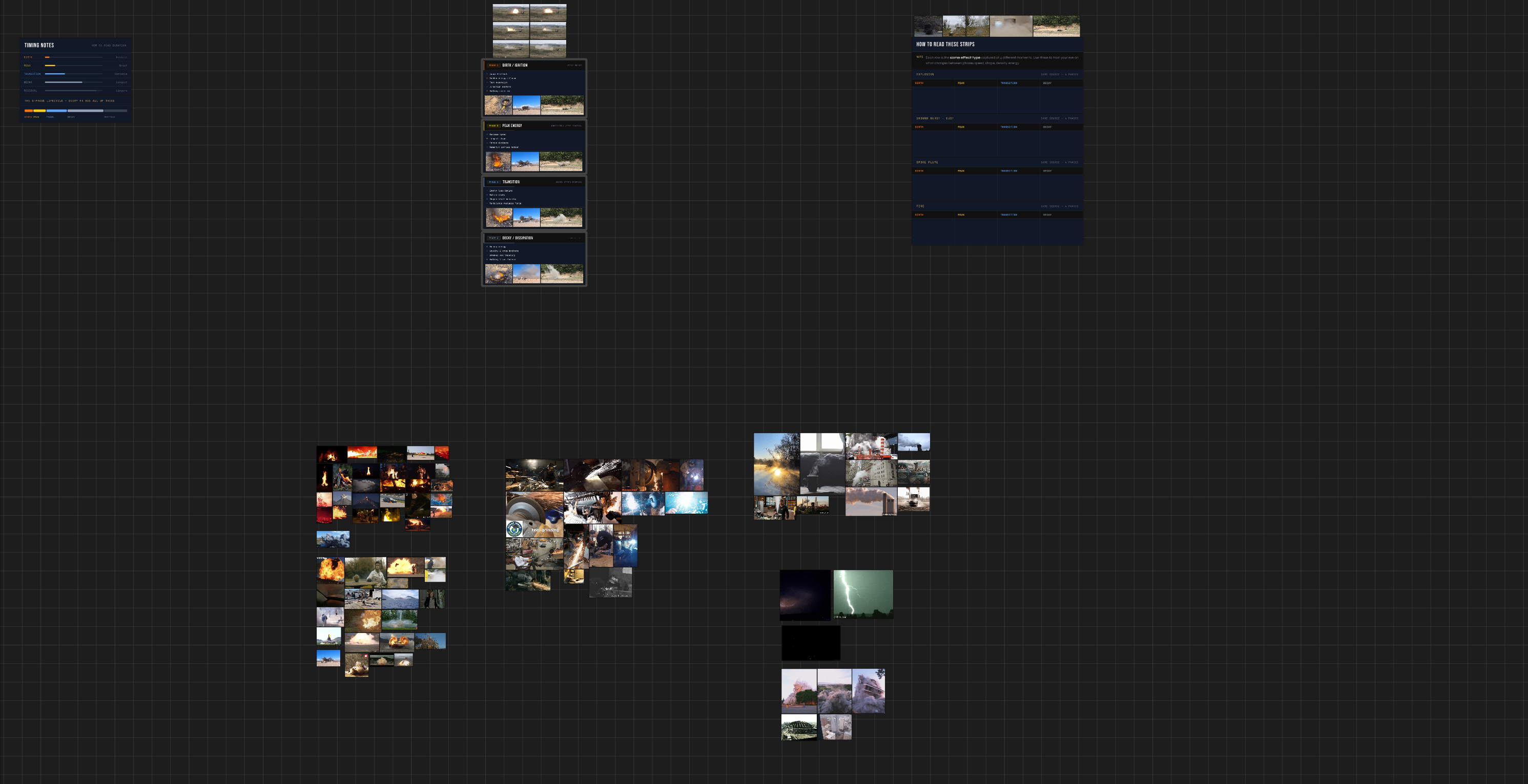
Before you build anything you need to know how to look at the real world and extract usable data from it. This module teaches you how to gather reference that actually helps, how to break any real-world event into its component parts, and how to read a lifecycle from birth to death. Most artists skip this step. The ones who do not are the ones whose work looks different.
3 Art Fundamentals for FX Artists
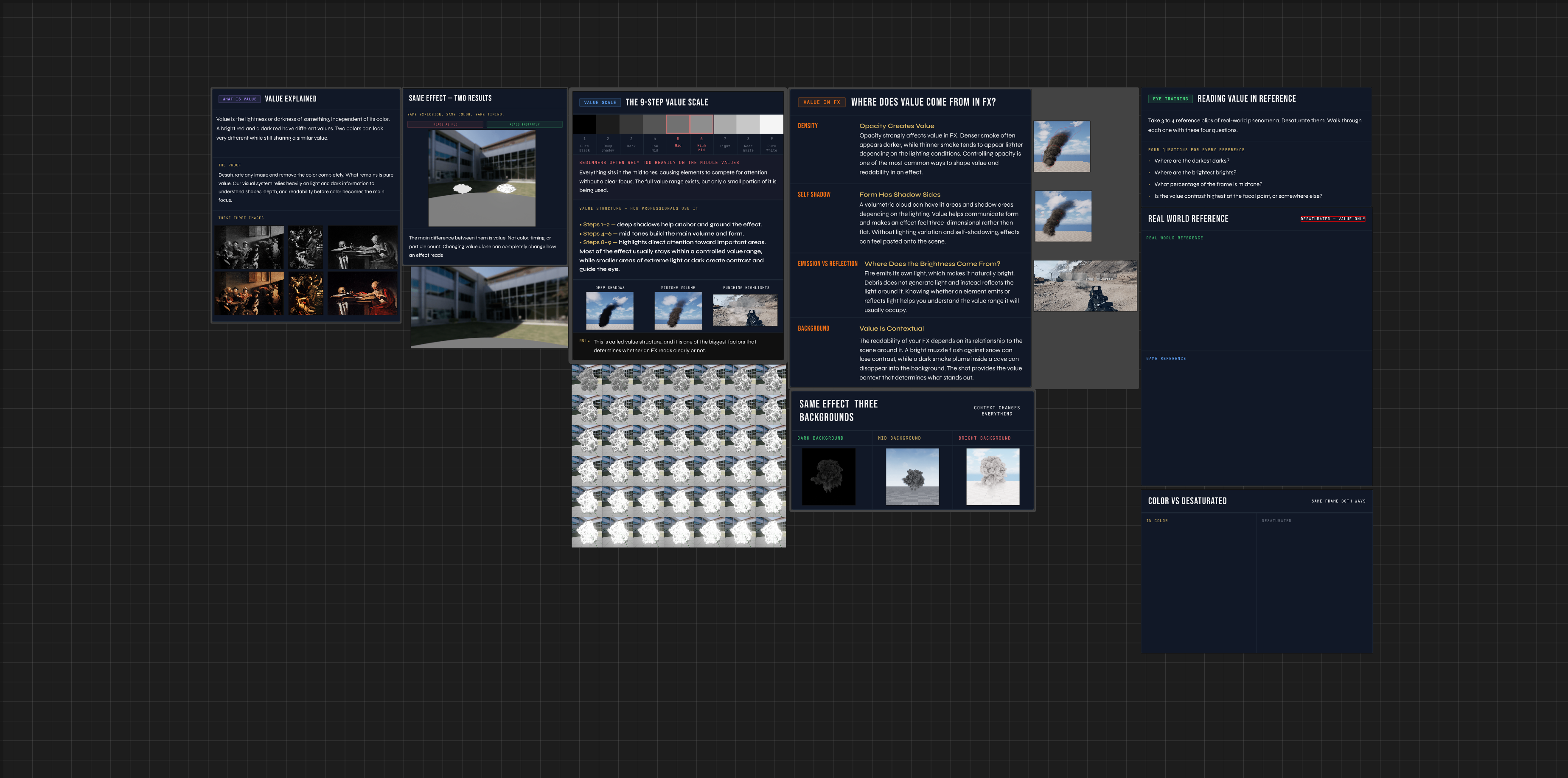
Five lessons. Five fundamentals that every great FX artist uses whether they know it or not. Value, color theory, light and form, composition, and negative space — each one taught through the specific lens of real-time FX. Not how a painter uses them. How you use them. By the end of this module you will have a complete visual framework for analyzing and building any effect.
Who Is This For?
- Anyone starting out and asking "where do I even begin?"
- Stylized FX artists wanting to make the jump to realism
- 3D artists curious about VFX as a career path
- Self-taught artists who can build effects but feel like something's "off" and can't name what
Requirements
Instructor
.png)

Mustafa Alobaidi
Senior VFX Artist
Hello, I'm Mustafa Al Obaidi, a passionate VFX artist with a rich background in the games industry. I've had the privilege of contributing to several noteworthy titles, including Battlefield 6, Gears of War Tactics, Shadow of War, and Solar Purge, most recently as part of the team at EA DICE.
Throughout my career, I've honed my skills in crafting immersive visual experiences that captivate audiences and elevate gameplay dynamics.
Beyond my professional work, I'm deeply committed to sharing my knowledge and expertise with aspiring artists and enthusiasts.
Known For:



No items found.
start your VFX journey

Realistic VFX Masterclass
Free
- ✓All Future Updates Included
- ✓Lifetime Access
- ✓Unlimited Q&A Support
- ✓Full access to all working files
Ready to Build
Realistic Effects?
Enroll in the Masterclass and start building production-quality VFX from day one.